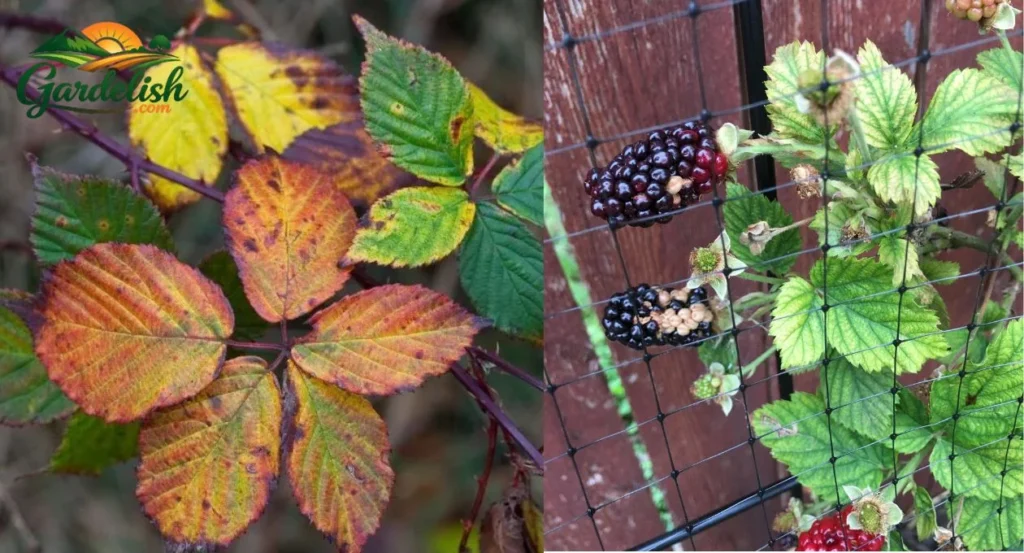
Blackberry leaves turning yellow usually means the plant is under stress from water, nutrients, soil pH, root trouble, disease, pests, or seasonal aging. The first clue is where the yellowing starts. Older lower leaves often point to nitrogen shortage, drought stress, or normal cane aging, while yellow young leaves with green veins often point to iron uptake trouble, commonly linked to alkaline soil. Yellow leaves with orange pustules, black spots, wilting, or cane dieback need closer inspection because disease or root damage may be involved.
Quick Answer
Blackberry leaves turn yellow most often from nitrogen deficiency, poor drainage, inconsistent watering, high soil pH, or rust disease. Check the pattern before treating: older leaves yellowing first suggests nitrogen, while young leaves yellowing between green veins suggests iron chlorosis. If the plant is yellow and wilting even though the soil is wet, inspect drainage and roots. Remove diseased canes, water deeply but not constantly, mulch lightly, and test the soil before adding more fertilizer.
Blackberry leaves turn yellow because the plant cannot move water, nutrients, or energy properly
Yellowing is called chlorosis, which means the leaf is losing chlorophyll. In blackberries, chlorosis is not a diagnosis by itself. It is a signal.
A healthy blackberry cane should carry firm, green leaves, strong primocane growth, and a steady canopy through the active growing season. When I see a blackberry patch starting to yellow, I look at four things before reaching for fertilizer: soil moisture, leaf pattern, cane age, and whether the problem is spreading.
Blackberries are vigorous plants, but they are not carefree. They dislike waterlogged soil, they need steady moisture while fruit is sizing up, and they respond poorly to guesswork fertilizing. Oregon State notes that pale green or yellow primocane leaves, especially toward the base of the cane, can indicate nitrogen deficiency, but similar symptoms may also come from insects, disease, or other stress.
Yellow lower leaves usually mean nitrogen deficiency, old leaves, or stress at the root zone
When the oldest leaves near the base of the cane turn pale yellow first, nitrogen is one of the most likely causes. Nitrogen moves within the plant, so blackberries pull it from older leaves to support newer growth when supplies run short. The result is a plant that looks green at the tips but tired and yellow down low.
You are more likely to see this in sandy soil, heavily mulched beds where microbes are tying up nitrogen, older plantings, or container blackberries that have been watered frequently. It can also happen in spring when growth surges.
How to fix it
- Check that the soil is moist, not soggy or bone dry.
- Apply a balanced berry fertilizer or a nitrogen-containing fertilizer according to the label.
- Keep fertilizer off the crown and canes.
- Water after applying granular fertilizer.
- Watch new growth for improvement over the next two to four weeks.
Do not expect badly yellowed old leaves to turn dark green again. The better sign is that new leaves emerge greener and the primocanes regain vigor.
Yellow leaves with green veins usually mean iron or magnesium uptake trouble
Yellow leaf tissue with green veins is a different clue. On blackberries, interveinal yellowing on younger leaves often points to iron deficiency or iron lockup. Oregon State lists iron deficiency in blackberry as interveinal yellowing of younger leaves, while magnesium deficiency tends to show on older leaves with interveinal chlorosis or reddening along the leaf edge.
The important word is “uptake.” Many gardens have iron in the soil, but the plant cannot use it when pH is too high, roots are damaged, or soil stays too wet. Illinois Extension notes that iron becomes less available as soil pH rises, and that drainage, compaction, root injury, and poor root growth should be ruled out when diagnosing chlorosis.
How to fix it
- Test soil pH before adding iron.
- Improve drainage if water stands after rain.
- Avoid piling compost or mulch against the crown.
- Use chelated iron only as a temporary green-up, not as the whole solution.
- Adjust pH gradually using soil-test recommendations.
For most garden blackberries, a soil pH in the mildly acidic range is suitable, but the best target varies by region and soil type. OSU recommends monitoring soil pH every few years and adjusting with lime or elemental sulfur where needed.
Yellow leaves plus wilting usually mean the roots are too wet, too dry, or damaged
This is the symptom combination gardeners misread most often. A blackberry can wilt and yellow in wet soil because damaged roots cannot breathe or absorb water. Waterlogged soil pushes oxygen out of the root zone, and the top of the plant behaves as if it is thirsty.
Blackberries need consistent moisture, especially during fruiting, but not standing water. OSU recommends 1 to 1.5 inches of water per week during the growing season for established blackberries, with irrigation adjusted for soil type, growth stage, and weather. The soil should be wetted deeply without allowing standing water to accumulate.
How to check the root zone
- Dig 6 to 8 inches down near the drip line.
- Squeeze a handful of soil.
- If it drips or smells sour, stop watering and improve drainage.
- If it falls apart dusty and dry, water slowly and deeply.
- If a container blackberry is involved, check that water exits freely from the drainage holes.
Raised beds and large containers can save blackberries in heavy clay, but the pot or bed must drain well. OSU recommends deep containers for blackberries because the plants are relatively deep rooted.
Yellow spots, orange pustules, or leaf blotches mean disease may be involved
Not all yellow blackberry leaves are nutrient problems. Rust diseases and leaf spots can begin as yellow marks before the leaf browns or drops.
Cane and leaf rust often shows as yellow pustules on the underside of leaves and can defoliate susceptible blackberry cultivars in severe cases. UC IPM notes that wet spring conditions favor this disease and that removing fruited canes after harvest helps reduce the source of infection.
Orange rust is more serious. It is systemic, meaning it infects the plant internally. The Pacific Northwest Pest Management Handbook describes infected plants as producing weak, spindly shoots in spring, with stunted, misshapen, pale green to yellow leaves and bright orange pustules on leaf undersides. Infected plants should be removed and destroyed, including the roots.
Blackberry yellow leaf diagnosis table
| What you see | Most likely cause | What to do first |
| Older lower leaves turn pale yellow | Nitrogen deficiency or natural aging | Feed lightly, check soil moisture, monitor new growth |
| Young leaves yellow between green veins | Iron chlorosis, high pH, root stress | Test pH, improve drainage, avoid overfertilizing |
| Older leaves yellow between veins or redden at edges | Magnesium deficiency or stress | Soil test before adding amendments |
| Yellow leaves with wilt in wet soil | Poor drainage or root rot risk | Stop frequent watering, improve drainage, inspect roots |
| Yellow leaves with dry edges | Drought stress, potassium issue, heat stress | Deep water, mulch, check fertility |
| Yellow spots with orange or yellow pustules underneath | Rust disease | Remove infected material, improve airflow, identify rust type |
| Yellowing on only one cane or one side | Cane injury, root damage, disease | Inspect cane base, prune dead or diseased wood |
| A few old yellow leaves in late season | Natural leaf aging | Remove only if diseased or messy |
You can fix yellow blackberry leaves by diagnosing before treating
The fastest way to make the problem worse is to apply fertilizer, Epsom salt, iron, compost, and extra water all in the same week. Blackberries respond better to one clear correction.
Step-by-step rescue plan
- Map the yellowing. Note whether it starts on old leaves, new leaves, one cane, or the whole plant.
- Check moisture deeply. Do not judge by the dry surface alone.
- Look under leaves. Rust pustules, mites, aphids, and spotting often hide there.
- Inspect the canes. Remove dead, fruited, damaged, or diseased canes.
- Test soil pH and nutrients. This matters more for perennial fruit than quick guesses.
- Feed only when the pattern supports it. Nitrogen helps nitrogen deficiency, but it will not fix wet roots or orange rust.
- Mulch correctly. Keep mulch a few inches away from the crown so the base does not rot.
- Track the response. New growth tells the truth faster than old damaged leaves.
You prevent yellow leaves by managing water, pruning, mulch, and soil health season by season
Most yellow-leaf problems are easier to prevent than reverse. The best blackberry patches I have worked with have open canopies, steady irrigation, clean pruning, and no mulch volcano around the crown.
| Season | What to do | Why it helps |
| Early spring | Remove dead canes, check soil pH, apply fertilizer if needed | Supports new primocane growth |
| Late spring | Watch for rust pustules, aphids, and uneven yellowing | Problems are easier to stop early |
| Summer | Water deeply, mulch lightly, avoid wetting foliage | Reduces drought stress and leaf disease |
| Harvest period | Pick regularly and remove spoiled fruit | Reduces pests and disease pressure |
| After harvest | Cut out spent floricanes and dispose of diseased material | Lowers overwintering disease sources |
| Fall | Adjust pH if soil test recommends it | Amendments work gradually |
| Winter | Keep crowns protected but not buried | Reduces cold injury and crown rot |
Good airflow matters more than beginners expect. Crowded blackberry rows stay wet after rain and dew, which encourages fungal problems. Bramble guidance from UMN notes that good air movement helps leaves dry faster and reduces disease problems.
Common mistakes that make yellow blackberry leaves worse
The first mistake is watering more when the plant is already in wet soil. Wilt does not always mean thirst. Sometimes it means the roots are suffocating.
The second mistake is adding nitrogen late and heavily. Too much nitrogen can push soft, leafy growth that is more vulnerable to disease and may reduce fruiting. OSU cautions that excessive nitrogen does not increase yield and that fertilizer rates should be adjusted based on plant growth and testing.
The third mistake is ignoring cane age. Blackberries fruit on canes that have a life cycle. Fruited floricanes naturally decline and should be removed after harvest. Leaving old canes in place creates shade, crowding, and disease carryover.
The fourth mistake is treating every orange or yellow mark as a nutrient issue. Orange rust is not fixed with fertilizer. Infected plants need removal.
FAQs about blackberry leaves turning yellow
Should I remove yellow leaves from blackberry plants?
Remove yellow leaves if they are diseased, spotted, moldy, or covered with rust pustules. A few older yellow leaves near the base can be left until they drop naturally, especially late in the season. Do not strip large amounts of foliage from a stressed blackberry because the plant still needs leaves to feed the roots and ripening fruit.
Can overwatering cause blackberry leaves to turn yellow?
Yes. Overwatering and poor drainage can turn blackberry leaves yellow because roots need oxygen as well as moisture. If soil stays soggy, roots cannot function properly, and the plant may wilt even though the ground is wet. Let the root zone become moist but not saturated, and improve drainage before adding fertilizer.
What fertilizer fixes yellow blackberry leaves?
Use fertilizer only after identifying the pattern. Older lower leaves turning uniformly yellow often respond to nitrogen. A balanced berry fertilizer, composted manure, or another nitrogen source can help when applied at the right rate. Yellow young leaves with green veins usually need pH correction or root improvement first, not simply more fertilizer.
Why are my blackberry leaves yellow with green veins?
Yellow leaves with green veins usually indicate interveinal chlorosis. On new blackberry leaves, this often points to iron uptake trouble, commonly connected with high soil pH, wet soil, compacted soil, or damaged roots. Test the soil before adding amendments because the issue is often unavailable iron rather than a complete absence of iron.
Are yellow blackberry leaves normal in fall?
Some yellowing is normal late in the growing season, especially on older leaves and canes that already fruited. The concern is yellowing that appears early, spreads quickly, affects new growth, comes with wilting, or includes spots, pustules, or cane dieback. Seasonal aging should look gradual, not sudden or patchy.
Can rust make blackberry leaves yellow?
Yes. Cane and leaf rust can cause yellow pustules on canes and leaf undersides, followed by yellowing and defoliation in severe infections. Orange rust can also produce pale yellow, distorted new leaves and bright orange pustules underneath. Cane and leaf rust can often be managed with sanitation, but orange rust-infected plants should be removed.
Why are my potted blackberry leaves turning yellow?
Potted blackberries yellow from inconsistent watering, nutrient leaching, cramped roots, poor drainage, or exhausted potting mix. Containers dry faster than garden soil but can also stay soggy if drainage is poor. Use a large, deep container, water thoroughly when the mix begins to dry, and feed modestly during active growth.
Conclusion
Blackberry leaves turning yellow are a warning sign, but they are not a reason to panic. Start with the pattern: old leaves, new leaves, veins, spots, wilt, or pustules. Then check soil moisture, drainage, cane health, and pH before applying fertilizer. Nitrogen helps when older leaves are pale and growth is weak, but it will not repair soggy roots, high-pH chlorosis, rust, or old overcrowded canes. The best long-term prevention is steady deep watering, well-drained soil, yearly pruning, clean sanitation, light mulch, and soil testing every few years. A blackberry plant with strong roots and open, well-fed canes usually grows through minor yellowing and returns to productive, dark green growth.
Mango Tree Not Fruiting? Here’s What to Check First