The latest Florida orange crop update is cautiously better than earlier expectations, but it is not a full recovery. USDA’s April 2026 forecast puts Florida’s 2025–2026 all-orange crop at 12.2 million boxes, up 200,000 boxes from January, yet still slightly below last season’s revised production. The real story is not one bad season; it is the long grind of citrus greening, hurricane stress, fruit drop, smaller fruit, and fewer productive acres. For home gardeners, the message is simple: Florida citrus can still be grown, but orange trees now need sharper scouting, better nutrition, and realistic expectations.
Quick Answer
Florida’s 2025–2026 orange crop is forecast at 12.2 million boxes, with 4.70 million boxes of non-Valencia oranges and 7.50 million boxes of Valencia oranges. That is a small improvement from January, but the crop remains historically tight because of citrus greening, storm damage, fruit drop, and reduced acreage. The next and final USDA forecast for the season is scheduled for July 10, 2026.
The latest Florida orange crop update is 12.2 million boxes
USDA’s April forecast is the most current official Florida citrus forecast available before the July final update. Non-Valencia oranges—early, midseason, and Navel types—are already harvested, so that part of the crop is based on estimated utilization. Valencia oranges, Florida’s classic juice orange, remain the larger share of the crop, but USDA reported below-average final fruit size and 46% final droppage for Valencia fruit.
| Crop item | Latest 2025–2026 forecast | What it means |
| All Florida oranges | 12.2 million boxes | Slightly better than January, still tight |
| Non-Valencia oranges | 4.70 million boxes | Harvest is over for the season |
| Valencia oranges | 7.50 million boxes | Unchanged from January |
| Valencia fruit drop | 46% | Above average and a major yield drag |
| Florida grapefruit | 1.25 million boxes | Up from January |
| Florida lemons | 900,000 boxes | A bright spot, up sharply from January |
In practical terms, a bump of 200,000 boxes is welcome, but it does not undo years of decline. Florida’s 2024–2025 all-orange production was already down sharply from the previous season, and bearing citrus acreage fell by 61,400 acres from 2023–2024 to 2024–2025.
The crop is still under pressure because greening, storms, and acreage loss compound each other
Citrus greening, also called Huanglongbing or HLB, is the main long-term problem behind Florida’s orange struggles. UF/IFAS describes it as a devastating disease that lowers yield and eventually makes infected trees unproductive; it is spread by the Asian citrus psyllid. Once a tree is infected, there is no cure, which is why commercial growers and homeowners focus on psyllid control, clean nursery stock, tree health, and removal of unproductive trees.
Hurricanes make the problem worse. A strong, healthy orange tree can still lose fruit in wind, but an HLB-weakened tree often has a thinner canopy, stressed roots, and fruit that drops more easily. That is why a grove can look green from the road yet still carry fewer marketable oranges than expected. WUSF reported that Florida’s 2024–2025 harvest was the lowest in more than 100 years, with the industry hit by hurricane damage, citrus greening, and development pressure on groves.
Acreage loss matters just as much as disease. Fewer bearing acres means fewer trees available to carry the crop, even in a decent weather year. The commercial inventory was reported down 24% from a year earlier, while Florida lawmakers approved major funding for new disease-resistant trees, grove management, therapeutic tools, and rehabilitation of existing trees.
The consumer takeaway is tighter Florida juice supply, not zero oranges
This update does not mean oranges are disappearing from stores. It does mean Florida-grown juice oranges remain limited compared with the state’s historic output. California now accounts for a much larger share of U.S. fresh citrus production, while Florida’s orange identity is still closely tied to juice varieties such as Valencia and Hamlin. UF/IFAS notes that Valencias are known for sweet, bright-orange juice, while Navels are popular for fresh eating.
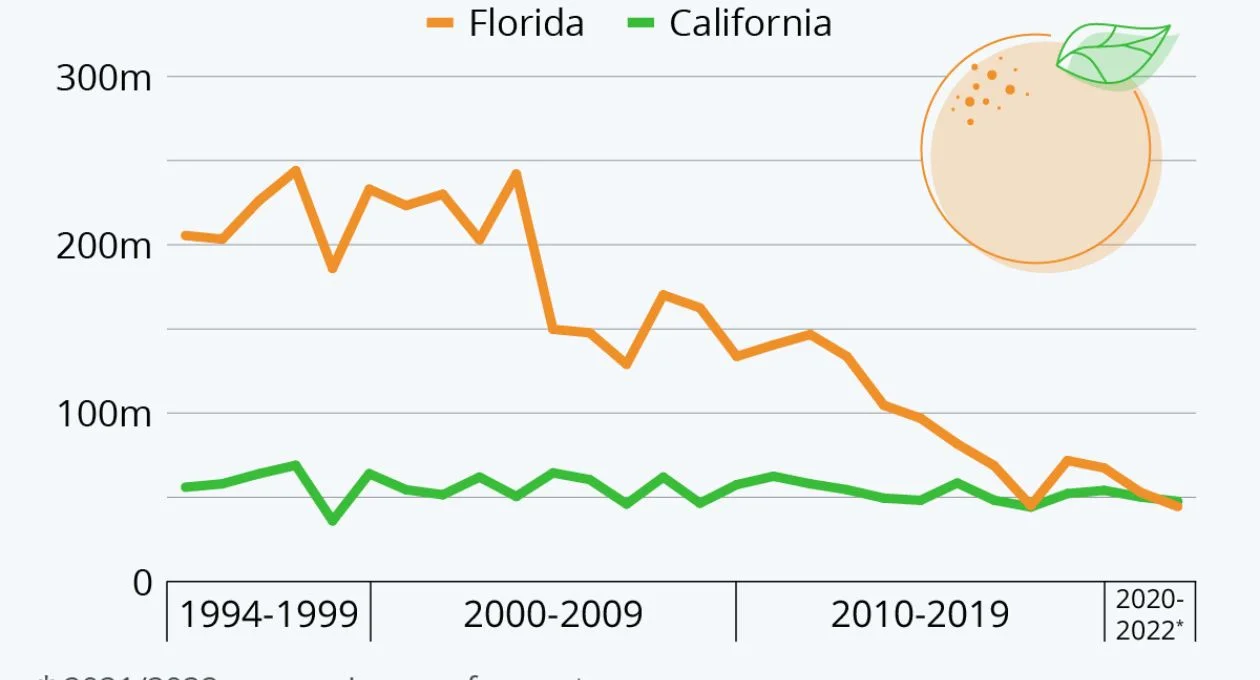
For shoppers, that can show up as higher prices, more blended supply, more imported juice, or less Florida-specific labeling. For gardeners, it is a reminder that the same pressures affecting commercial groves—HLB, psyllids, heat, storms, and inconsistent water—also show up in backyard orange trees.
The home-garden lesson is to diagnose before you fertilize harder
The mistake many Florida homeowners make is treating every yellow citrus leaf as a fertilizer problem. Sometimes it is. Citrus are heavy feeders, especially in sandy soils and during active growth. But HLB can mimic nutrient issues, and nutrient deficiencies can mimic disease. The first thing to check is the pattern.
| Symptom gardeners notice first | Possible cause | What to do now | Prevention |
| Blotchy yellow leaves that are uneven on both sides of the midrib | Citrus greening/HLB | Photograph leaves and fruit; contact county Extension | Buy certified trees, manage psyllids, avoid moving infected plants |
| Uniform yellowing on older leaves | Nitrogen or general nutrient deficiency | Apply citrus fertilizer according to label and tree age | Feed lightly but regularly during the growing season |
| Small, lopsided, bitter fruit with green blossom end | Possible HLB | Check for other HLB symptoms; contact Extension | Scout for Asian citrus psyllid and protect new flush |
| Sudden fruit drop after storms or drought | Weather stress, root stress, HLB, irrigation swings | Deep water during dry spells; avoid overcorrecting | Mulch properly, maintain steady irrigation |
| Leaf distortion on tender new growth | Psyllids, aphids, leafminers | Inspect young flush closely | Screen young trees and scout weekly during flush |
| Sparse canopy and twig dieback | HLB, root stress, freeze damage, neglect | Remove dead wood; assess whole tree vigor | Choose the right site, protect from frost, maintain nutrition |
HLB symptoms are most visible from September through March and include blotchy mottled leaves, yellow shoots, dieback, sparse foliage, off-season bloom, small misshapen fruit, and poor flavor. UF/IFAS recommends contacting your local Extension office if you suspect greening.
The best backyard response is prevention, not rescue
Once HLB is established, the goal shifts from “curing” the tree to deciding whether the tree is still productive enough to keep. For a new orange tree, prevention starts before planting.
- Buy only certified nursery citrus. Do not dig up, share, or move unknown citrus trees around Florida.
- Plant in full sun with good drainage. Citrus tolerates light shade but produces better in full sun, and UF/IFAS recommends at least 15 feet between home citrus trees.
- Protect young trees from psyllids. UF/IFAS recommends greening-tolerant varieties such as ‘Sugar Belle,’ insect screening for young trees, regular citrus fertilizer, frequent establishment watering, and scouting for leafminer, aphids, and citrus psyllid.
- Water deeply, then let the soil breathe. Young trees need steady water while roots establish, but soggy soil invites root trouble.
- Fertilize lightly and consistently. Young trees do better with small, regular feedings than occasional heavy doses. UF/IFAS recommends light, frequent fertilizer applications for young trees and four to five applications per year after the third year.
- Prune only what needs pruning. Mature citrus does not need heavy pruning except for serious disease or freeze damage; unnecessary pruning can reduce fruit production.
For climate, sweet oranges are best treated as subtropical fruit. In Florida, that means choosing planting sites that do not regularly freeze, using cold-hardy citrus in colder north Florida pockets, and checking the USDA Plant Hardiness Zone Map for your exact location before planting marginal varieties.
The seasonal care calendar should match Florida’s citrus stress points
| Season | What orange trees need | What gardeners often miss |
| Winter | Frost protection, light cleanup, disease scouting | HLB symptoms are easier to see in cool months |
| Spring | New flush protection, irrigation checks, first fertilizer rounds | Psyllids target tender new growth |
| Summer | Deep watering, mulch, storm preparation | Heat and drought stress can trigger fruit drop |
| Fall | Canopy inspection, fruit monitoring, steady nutrition | Early greening signs can be mistaken for hunger |
A good citrus tree in Florida is rarely a “plant it and forget it” tree anymore. The gardeners who get fruit are usually the ones who notice changes early: a branch that yellows differently from the rest, fruit that stays green at one end, or new growth curling before it hardens.
FAQs About the Florida Orange Crop Update
Is Florida having an orange shortage in 2026?
Florida is not out of oranges, but the crop remains tight. USDA forecasts 12.2 million boxes for 2025–2026, only slightly better than the January estimate. The bigger issue is that production is still far below historic levels because citrus greening, storm damage, fruit drop, and fewer bearing acres continue to limit recovery.
Why are Florida orange crops so much smaller now?
The biggest reason is citrus greening, a disease spread by the Asian citrus psyllid. It weakens trees, reduces fruit quality, and eventually makes trees unproductive. Hurricanes, acreage loss, development pressure, and high production costs add more stress, so even when a forecast improves slightly, the industry is still rebuilding from a much smaller base.
Are Valencia oranges affected more than other oranges?
Valencia oranges remain Florida’s largest forecast category for 2025–2026 at 7.50 million boxes, but USDA reported below-average final fruit size and 46% final droppage. That matters because Valencia is a major juice orange. Smaller fruit and high drop mean fewer usable boxes even when trees carry a visible crop.
Can homeowners still grow orange trees in Florida?
Yes, but it is more challenging than it used to be. Choose certified nursery trees, favor greening-tolerant varieties where available, protect young trees from psyllids, and keep nutrition and irrigation consistent. In colder parts of north Florida, choose more cold-tolerant citrus or container plants that can be protected during freezes.
How do I know if my orange tree has citrus greening?
Look for blotchy yellow leaves that are uneven across the midrib, yellow shoots, sparse canopy, twig dieback, off-season bloom, small lopsided fruit, fruit that stays green at the blossom end, and bitter or off-flavored juice. Because nutrient problems can look similar, send photos or samples to your county Extension office before removing a tree.
Should I remove an orange tree with citrus greening?
If the tree is badly declining, producing poor fruit, or acting as a psyllid reservoir, removal is often the responsible choice. UF/IFAS notes there is no treatment for HLB-infected trees, and unproductive infected trees are usually destroyed to reduce spread. Contact your county Extension office for local disposal guidance.
When is Florida orange harvest season?
Florida orange harvest depends on variety. Non-Valencia early and midseason oranges are harvested earlier, while Valencia oranges extend later into spring and early summer. Backyard gardeners should taste fruit before harvesting the whole tree because citrus does not continue ripening after it is picked. A pull-snap-twist motion works well for mature fruit.
Conclusion
The 2026 Florida orange crop update is better than a pure bad-news headline, but it is not a true rebound yet. A 12.2-million-box forecast shows a small improvement from January, while high fruit drop, smaller Valencia fruit, citrus greening, hurricane stress, and lost acreage continue to hold Florida back. For shoppers, that means Florida orange juice supply may remain tight. For gardeners, the lesson is practical: start with certified trees, choose the right variety for your climate, protect new growth from psyllids, feed consistently, water wisely, and diagnose yellowing carefully before assuming fertilizer will fix everything. Good citrus now comes from prevention, not rescue.
Citrus Crop Forecast: What This Year’s Orange, Lemon, Grapefruit, and Mandarin Numbers Mean for Gardeners